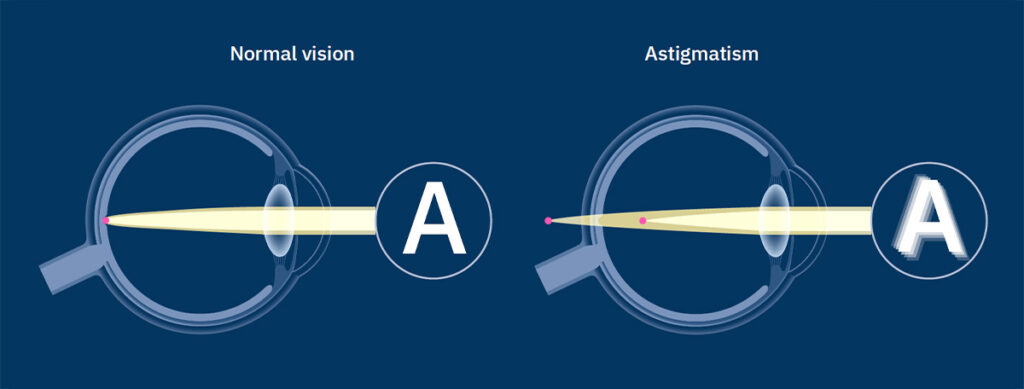
Astigmatism is a common eye condition in which light cannot focus on a single point on the retina. Instead, it forms multiple focus points, resulting in blurred or distorted vision at both near and far distances.
Common Symptoms
People with astigmatism may experience:
- Blurred or unclear vision
- Double vision in one eye
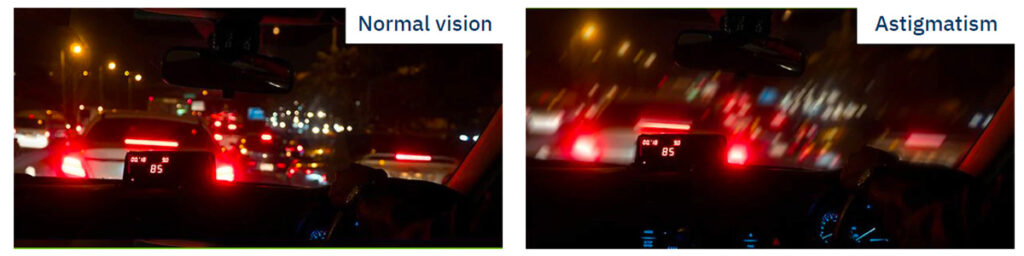
- Shadowing or “ghosting” of images
- Glare or light streaks, especially at night
What Causes Astigmatism?
Astigmatism usually occurs when the cornea (the front surface of the eye) has an irregular shape.
It can also be associated with certain eye conditions, such as:
- Pterygium
- Keratoconus
These conditions affect the curvature of the cornea and alter how light enters the eye.
Why Do Some Glasses Feel Uncomfortable?
Some patients feel uncomfortable when wearing glasses for astigmatism, with symptoms like:
- Dizziness
- Eye strain or headaches
- Distorted or “tilted” vision
- Difficulty adjusting
Because of this, some people choose to remove the astigmatism correction from their glasses to feel more comfortable.
However, this may lead to suboptimal vision in the long term.
What Makes an Accurate Prescription?
Astigmatism correction is more complex than just a single number. It includes:
- Cylinder Power – the strength of astigmatism
- Axis – the direction of the astigmatism (ranging from 1 to 180 degrees)
Even a small error in the axis, especially in higher astigmatism, can significantly affect vision quality.
Types of Astigmatism
Astigmatism can be classified based on the axis:
1 With-the-rule astigmatism
- The cornea is steeper vertically
- Common in younger individuals
2 Against-the-rule astigmatism
- The cornea is steeper horizontally
- More common with aging
3 Oblique astigmatism
- The steepest curve lies at an angle
- Often requires more time to adapt to correction
Important Considerations
- A good prescription is not based on machine readings alone
- It must be tailored to the patient’s symptoms and daily visual needs
- Each person adapts differently to astigmatism correction
Even mild astigmatism with an oblique axis may feel more difficult to adjust to than higher astigmatism with a regular axis.
The goal is not to avoid astigmatism correction, but to:
✔ Get an accurate eye examination
✔ Receive a properly customized prescription
✔ Understand the adaptation process
This ensures the best possible visual quality in the long term.
บทความโดย อนิสรา ขอมั่งกลาง, O.D.นามิ นักทัศนมาตรร้านแว่นตา Glassisimo
References
- Prof. Dr. Sabong Srinanaboon. Fundamentals of Ophthalmology. Siriraj Press, Faculty of Medicine Siriraj Hospital, Mahidol University.
- Refocus Eye Health. With-the-Rule, Against-the-Rule, and Oblique Astigmatism. Accessed from
https://windsor.refocuseyedoctors.com/article/how-different-types-of-astigmatism-affect-your-eyesight/
(Accessed March 12, 2026) - Image of Astigmatism. Credit From
https://www.visiondirect.co.uk/eye-care-centre/what-is-astigmatism